QUASAR-CREATE · Thrust 2Quantum Security Assurance
Quantum Key Distribution (QKD) offers strong security under well-defined physical and protocol assumptions. Real deployments, however, depend on components, interfaces, implementation choices and operational conditions that may deviate from these assumptions. Thrust 2 develops the methods, tools and assurance workflows needed to evaluate whether QKD and QKDN systems deliver their intended security properties in practice.
Testing and evaluation methods for QKD and quantum-safe communication systems.

Why QKD Assurance Matters
The promise is strong. The implementation must be provable secure.
Quantum Key Distribution is designed to establish shared secret keys with information-theoretic security rooted in quantum physics. But deployed QKD systems depend on real devices, hardware and software components, classical interfaces, protocol variants, network integration, and operational procedures. Thrust 2 focuses on turning security claims into measurable assurance.
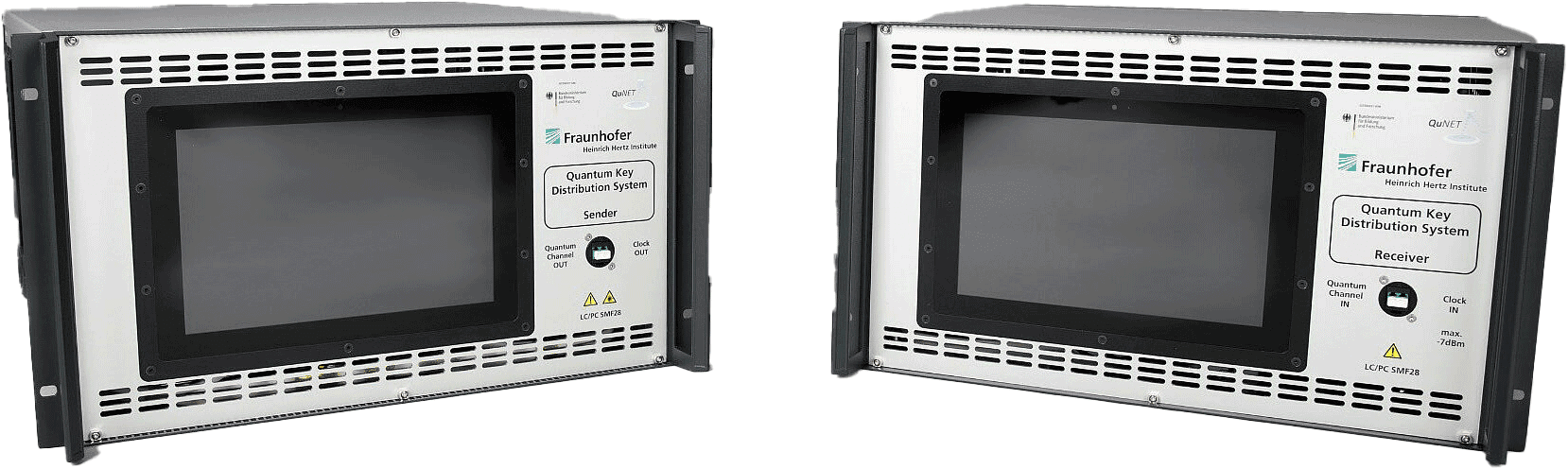
QKD enables two parties to establish a shared secret key. Under well-defined assumptions on the physical implementation of the protocol, security can be proven without relying on computational hardness assumptions.
Real systems may include uncharacterised components, optical and electronic side channels, fault-injection exposure, protocol adaptations and operational behaviours that are not fully captured by the security proof.
The question is not whether QKD can be secure. The question is how to evaluate whether a specific deployed system delivers the intended security properties.
What Thrust 2 Builds
The Missing Layer Between Security Proof and Security Certification
Professional evaluation of QKD systems requires more than isolated experiments or abstract proofs. It requires a structured way to connect mathematical security models, component characterization, attack testing, countermeasure validation, and certification-oriented evaluation criteria.
Thrust 2 develops this missing assurance layer.
From
Theoretical Security Proofs
Thrust 2 Assurance Framework
- Meta-language and numerical platform for practical security proofs
- Hardware characterization
- Vulnerability assessment
- Security Evaluation Tool
- Pass/fail criteria
- Evaluation workflows
- Standards alignment
To
Real QKD Systems & Networks
Research Areas
Six interconnected research and translational areas driving evidence-based quantum security assurance work.
Practical Security Proofs
Proof frameworks and numerical tools that can incorporate real-world implementation constraints, components characterization data, security measures, and interface with practical evaluation activities.
Key Outputs
- →Proof-to-implementation gap analysis
- →Meta-language for practical security arguments
- →Numerical tools for practical, finite-size key rate calculations
System Simulation & Attack Modeling
Developing models and tools to simulate practical QKD links, emulate attacks, and assist the design of evaluation activities.
Key Outputs
- →QKD system modeling at component & protocol level
- →Attack models and simulation tools for quantum and classical side-channel and implementation attacks
- →Simulation and iteration of evaluation activities
Security Evaluation Methodologies and Tools
Development of bespoke testing equipment, measurement protocols and analysis workflows.
Key Outputs
- →Development of testing equipment and application to QKD reference systems
- →Characterization of components
- →Investigation of hardware behaviour under adversarial manipulation
Quantum Hacking & Vulnerability Research
Investigation of practical attacks and security countermeasures.
Key Outputs
- →Attack vector taxonomy & vulnerability mapping
- →Experimental demonstrations of vulnerabilities and mitigations
- →Countermeasure development and validation
Classical + Quantum Security Integration
Integration of classical security evaluation methods with quantum-specific attack and assurance models.
Key Outputs
- →Combined classical-quantum evaluation workflows
- →Side-channel analysis across quantum and classical layers
- →Investigation of hardware trojans and key delivery pipeline
Standardization & Pre-Certification
Development of reusable evaluation criteria, test templates, and certification-oriented outputs that bridge research and deployment.
Key Outputs
- →Expansion of ISO/IEC 23837 evaluation activities
- →Contribution to background documents for in Common Criteria-aligned QKD security evaluation
- →Assurance level framework for QKD security
How Partners Can Engage
We build bridges between research and practice - through industry-focused collaboration, evaluation support, and open research partnerships.
For QKD Vendors
- →Pre-evaluation of QKD systems, components and security proofs
- →QKD system and component characterization
- →Vulnerability assessment and standards mapping
- →Countermeasure validation
For Operators & Agencies
- →Security architecture review
- →Deployment risk analysis
- →QKD network assurance and monitoring concepts
- →Evaluation planning
For Test Laboratories & Evaluation Bodies
- →Test method development
- →Modular evaluation toolchains
- →Evaluation workflow design
- →Certification-oriented evidence mapping
For Researchers
- →Joint research on practical security proofs
- →Quantum hacking experiments
- →Component characterization and modelling
- →Shared testbeds and publications
Research Team
Principal investigators and researchers from the QUASAR-CREATE consortium driving quantum communication security evaluation.

Harald Kuhn
Professor, Programme Lead-PI
Fraunhofer ENAS, TU Chemnitz

Michael Kasper
Assoc. Professor , Principal Investigator, Director Fraunhofer Singapore
Fraunhofer Singapore, NTU

Christian Kurtsiefer
Professor, Principal Investigator
National University Singapore (NUS)

Marco Tomamichl
Professor, Principal Investigator
National University Singapore (NUS)

Alexander Weiss
Professor, Principal Investigator
Fraunhofer ENAS, TU Chemnitz

Sze Thing Goh
Manager, Thrust 2 & 3
Fraunhofer Singapore, NTU

Elias X Huber
Coordinator, Thrust 2
Fraunhofer, Singapore

Wastu Wisesa
Research Associate, Thrust 2
Fraunhofer, Singapore

Ian George
Research Fellow, Thrust 2
Centre for Quantum Technologies (CQT), NUS

Becca Verghese
PhD Student, Thrust 2
Centre for Quantum Technologies (CQT), NUS

Leó Weissbart
Research Fellow
Nanyang Technological University (NTU)

Seth Hou Shun Poh
Senior Research Fellow, Thrust 2
Centre for Quantum Technologies (CQT), NUS

Bibhuti Thapa
PhD Student, Thrust 2
Centre for Quantum Technologies (CQT), NUS

Ethan Shak
Intern, Data Engineering (QKD Security)
Fraunhofer Singapore, NTU

Chun Long Tan
Intern, Data Engineering (QKD Security)
Fraunhofer Singapore, NTU
Work With Us on Quantum Security Evaluation
Thrust 2 collaborates with researchers, vendors, operators, test laboratories, and public-sector stakeholders to advance practical QKD security evaluation, certification readiness, and secure deployment of quantum communication systems.
Consulting
Support
Security evaluation, certification advisory, and training services.
Join the
Team
Explore job opportunities and PhD positions in our group.
Research Collaboration
Joint projects, and publication collaboration.
Training
& Workshops
Request training programmes and workshops on QKD and PQC security.